

I came across a post on a Swedish primary doctor Facebook page that mentioned a word I didn’t know existed. Eminence Based Medicine, at least according to some, is when there is no evidence to base your treatment plan on and you instead choose to trust experts. I guess in some cases, if we’re high enough or long enough into our careers, we might even venture to assume on our own what the best course of action is. “Expert opinion” is often used these days, but it doesn’t have the aura of eminence…
Intrigued by the expression itself, I started researching how new Eminence Based Medicine is, since it was all new to me. I found to my surprise that it was coined by Isaacs and Fitzgerald in 1999. They wrote:
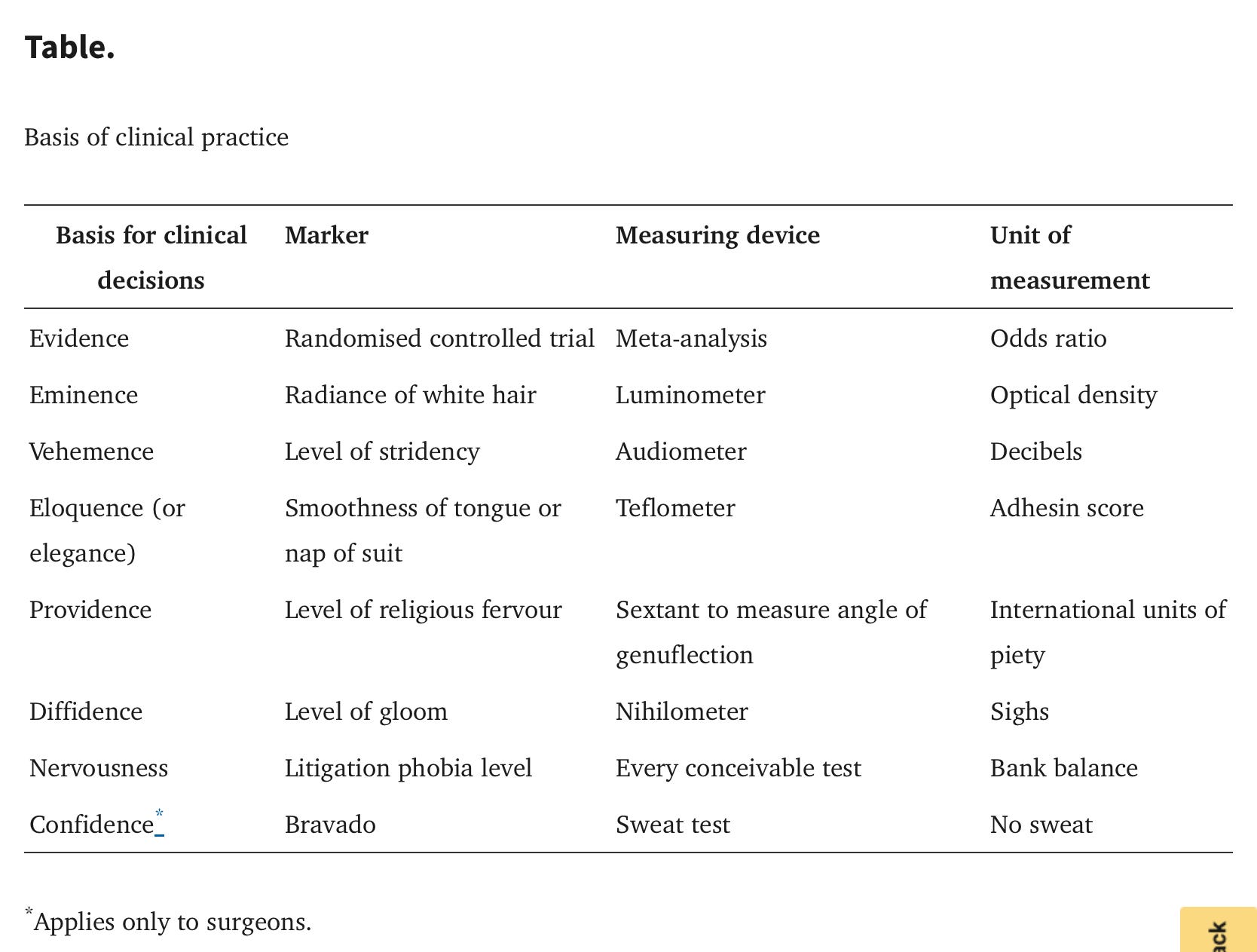
Clinical decisions should, as far as possible, be evidence based. So runs the current clinical dogma. We are urged to lump all the relevant randomised controlled trials into one giant meta-analysis and come out with a combined odds ratio for all decisions. Physicians, surgeons, nurses are doing it; soon even the lawyers will be using evidence based practice. But what if there is no evidence on which to base a clinical decision?
They introduced a bunch of other terms in the same vein as Eminence Based. Some were more comical than others. So here is a table from that 1999 article:
Love this - I hadn't come across the term "eminence-based medicine" before either, but I recognized it instantly once you named it.
In neurology, we have our own quiet version of it. A consultant sees a patient once, writes an impression, and that impression outlives the visit by years. Not necessarily because the evidence still supports it, but because it came from someone senior, sounded authoritative, and no one wanted to reopen the question. The diagnosis becomes eminent rather than evidence-based.
I'd argue the more dangerous cousin isn't eminence-based medicine, though - it's anchor-based medicine. You don't even need an eminent authority. You just need a plausible first diagnosis and enough time for everyone to stop questioning it.
Isaacs and Fitzgerald clearly had fun with this table, but there's a serious point underneath the humor: much of clinical practice operates on some blend of evidence, expert judgment, and diagnostic momentum. The important thing is recognizing which one is actually driving the decision in front of you.
I've missed your writing!